

The short answer: For lower-back pain, TENS electrodes are generally placed on healthy soft tissue around the painful area rather than directly over the spine. Keep both pads from one channel on the same local region, start with a clearly perceptible but comfortable tingling and stop if symptoms worsen. Placement cannot identify the cause of back pain, and TENS does not repair a disc, joint, muscle or nerve.
First, Identify What Kind of Back Pain You Have
“Lower-back pain” describes a location, not a diagnosis. It can follow a muscle strain, prolonged sitting, joint irritation, a disc problem, arthritis or irritation of a nerve. Pain that travels into one leg with tingling, numbness or weakness may need a different assessment from soreness that stays across the lower back.
Do not use temporary pain relief to mask warning signs. The NHS back-pain guidance advises emergency assessment for back pain with symptoms in both legs, loss of feeling around the genitals or anus, or new bladder or bowel changes. Severe pain after a major injury, rapidly worsening weakness, fever or unexplained weight loss also needs professional evaluation.
Can TENS Help Lower-Back Pain?
TENS sends mild electrical impulses through electrodes attached to the skin. The goal is to influence pain signaling, so any benefit is usually temporary and varies by person, condition and session.
The evidence is mixed. A systematic review prepared for the WHO guideline found very-low-certainty evidence of brief, marginal pain reduction for chronic primary low-back pain and little or no difference for most other outcomes. A 2026 review focused on TENS dose found no significant overall effect when dosing was ignored, but reported larger effects when stimulation was clearly perceptible and adjusted during treatment; the authors still rated the overall certainty low because studies differed substantially and had risk of bias.
The practical conclusion is modest: TENS may be worth a cautious trial for temporary comfort if it is appropriate for you, but it should not replace diagnosis, movement, exercise, sleep, medication or physical therapy when those are part of the plan. The WHO chronic low-back-pain guidance emphasizes person-centered care and often a combination of interventions rather than one passive treatment in isolation.

TENS Unit Placement for Lower-Back Pain
A common general approach uses two or four electrodes on the muscles beside the painful lower-back region. Keep the pads on intact soft tissue, leave space between them and avoid placing an electrode directly over the bony center of the spine. The exact pattern should follow your device manual or a clinician-confirmed plan.
Do not create a current path through the torso. For a single channel, keep both electrodes on the same side or across the local lower-back area as permitted by the instructions. Do not place one pad on the lower back and the paired pad on the abdomen or chest. If pain travels down the leg, our sciatica TENS guide explains why placement should follow the painful pathway and diagnosis rather than a generic diagram.
Two-Pad Placement
With one channel, place one pad above and one below the painful region, or on either side of it, while staying on healthy soft tissue and away from the spine. Keep a gap between the electrodes so their edges do not touch. If the skin is numb or you cannot judge intensity reliably, do not place a pad there.
Four-Pad Placement
A dual-channel unit can control two pad pairs independently. A clinician may arrange four electrodes around a broader painful area, with one pair on each side of the lower back. Treat each channel as a separate circuit and adjust the intensity independently because sensation may differ. Read our dual-channel TENS guide before using both outputs.
How to Set Up a Lower-Back TENS Session
- Confirm that self-care is appropriate and that no urgent warning signs are present.
- Read the manual, contraindications and approved placement instructions.
- Turn the unit off before connecting lead wires or handling electrodes.
- Clean and dry intact skin; do not apply lotion beneath the pads.
- Apply the pads around the painful area without placing them directly on the spine.
- Select TENS mode and begin at the lowest intensity.
- Increase gradually to a strong, clear but comfortable tingling.
- Stop if the sensation burns, stings, becomes painful or causes forceful movement.
- Switch the unit off before moving or removing any electrode.
Follow the schedule in the device instructions or your clinician's plan. Session length is not universal, and keeping the unit on longer is not automatically more effective. See our guide to how long to use a TENS unit for the factors that affect timing.

Lower-Back Areas to Avoid
- Do not place electrodes directly over the spine or prominent bone.
- Do not pair a lower-back pad with a pad on the abdomen or chest.
- Do not use on broken, infected, irritated, swollen or numb skin.
- Do not place pads over a fresh incision or an area with reduced sensation.
- Do not use while sleeping, bathing, driving or operating machinery.
Ask a healthcare professional before using TENS if you are pregnant; have a pacemaker, implanted defibrillator or another electronic implant; have epilepsy, heart disease, cancer, circulation problems or reduced sensation; or recently had surgery. Review our complete TENS contraindications checklist before starting.
What the Sensation Should Feel Like
TENS mode usually feels like a steady or pulsing tingle without a forceful contraction. More intensity is not automatically better. A sharp point, burning feeling or uneven sensation often indicates high intensity, poor pad contact, a lifting edge or a worn electrode.
Turn the unit off before inspecting anything. Make sure the lead is fully connected and the entire adhesive surface contacts clean, dry skin. Replace electrodes that are dry, torn or no longer stick evenly. Our guide to cleaning and maintaining TENS pads explains when gentle care may help and when replacement is safer.
TENS vs EMS on the Lower Back
| Feature | TENS | EMS |
|---|---|---|
| Main purpose | Temporary pain modulation | Muscle activation or contraction |
| Expected feeling | Strong but comfortable tingling | Rhythmic or visible contraction |
| Placement basis | Around an appropriate painful area | Over a target muscle or motor point |
| Repairs a disc or joint | No | No |
Do not copy the same pad pattern when switching modes. EMS for back rehabilitation should follow a clinician-designed plan, especially after an injury or surgery. Review our TENS vs EMS comparison before changing modes.
Choosing a Unit for Back Pain
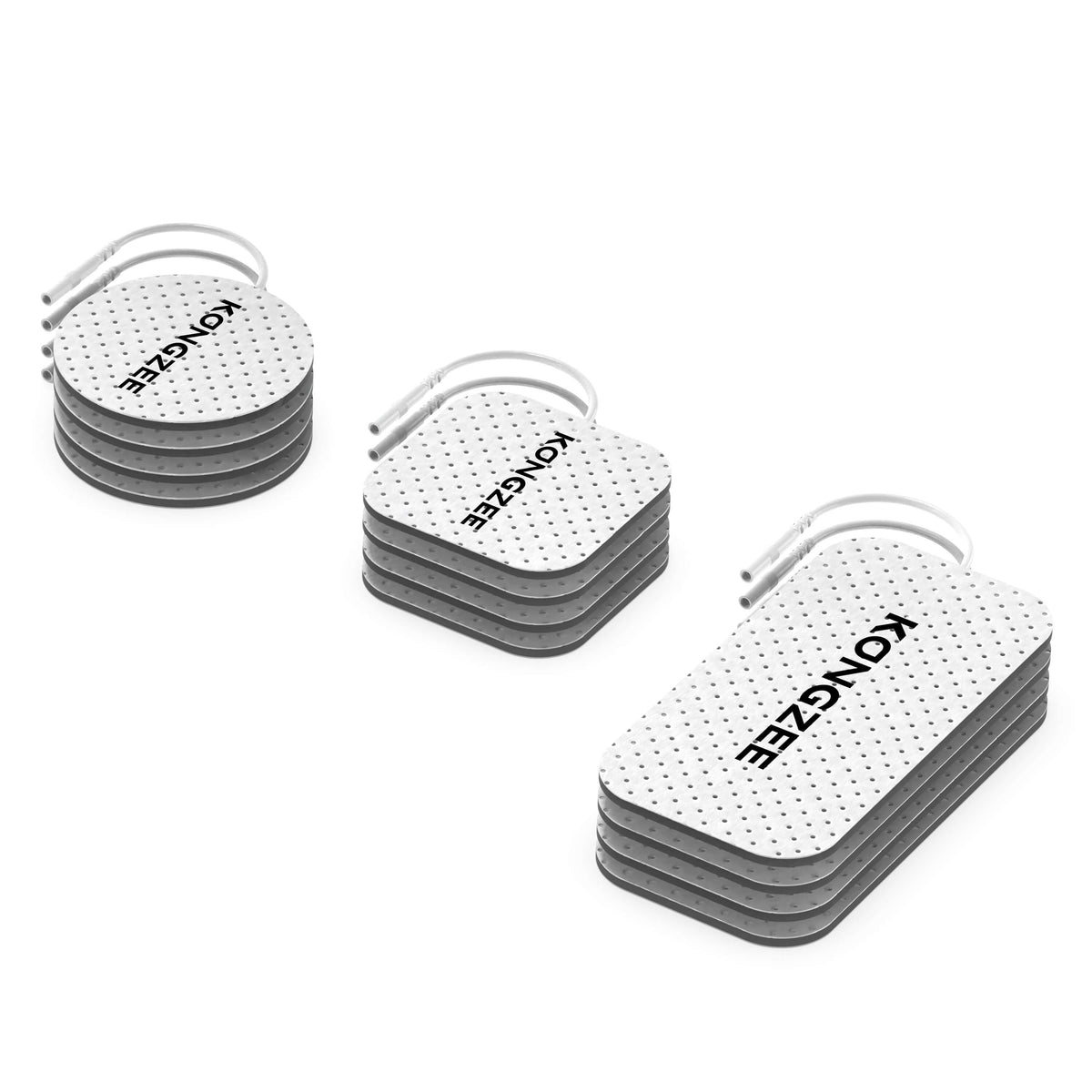
Prioritize clear mode labels, gradual intensity control, secure lead connections, compatible replacement pads and readable safety instructions. Independent dual channels can help when two pad pairs are recommended, but extra channels do not make an unsafe placement acceptable.
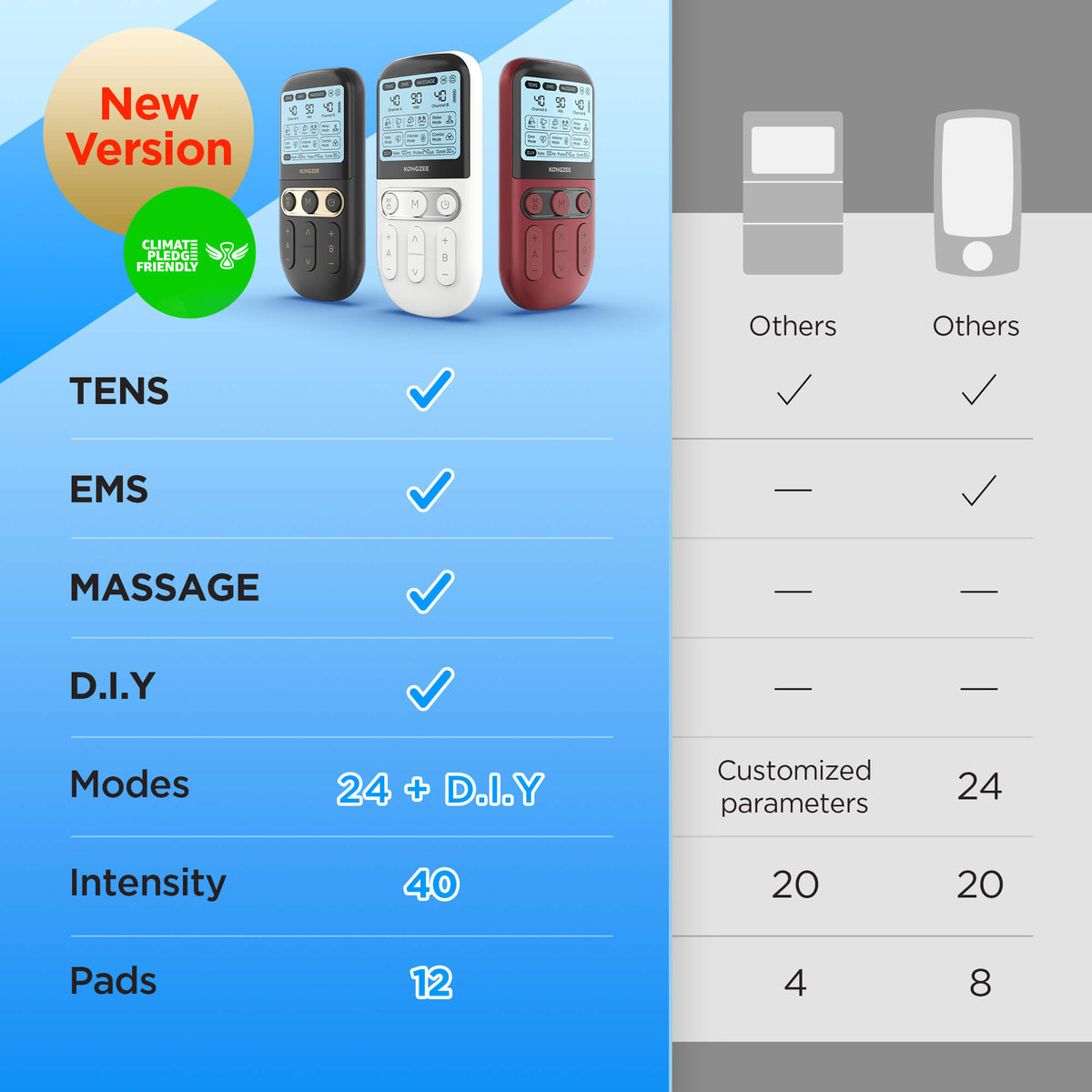
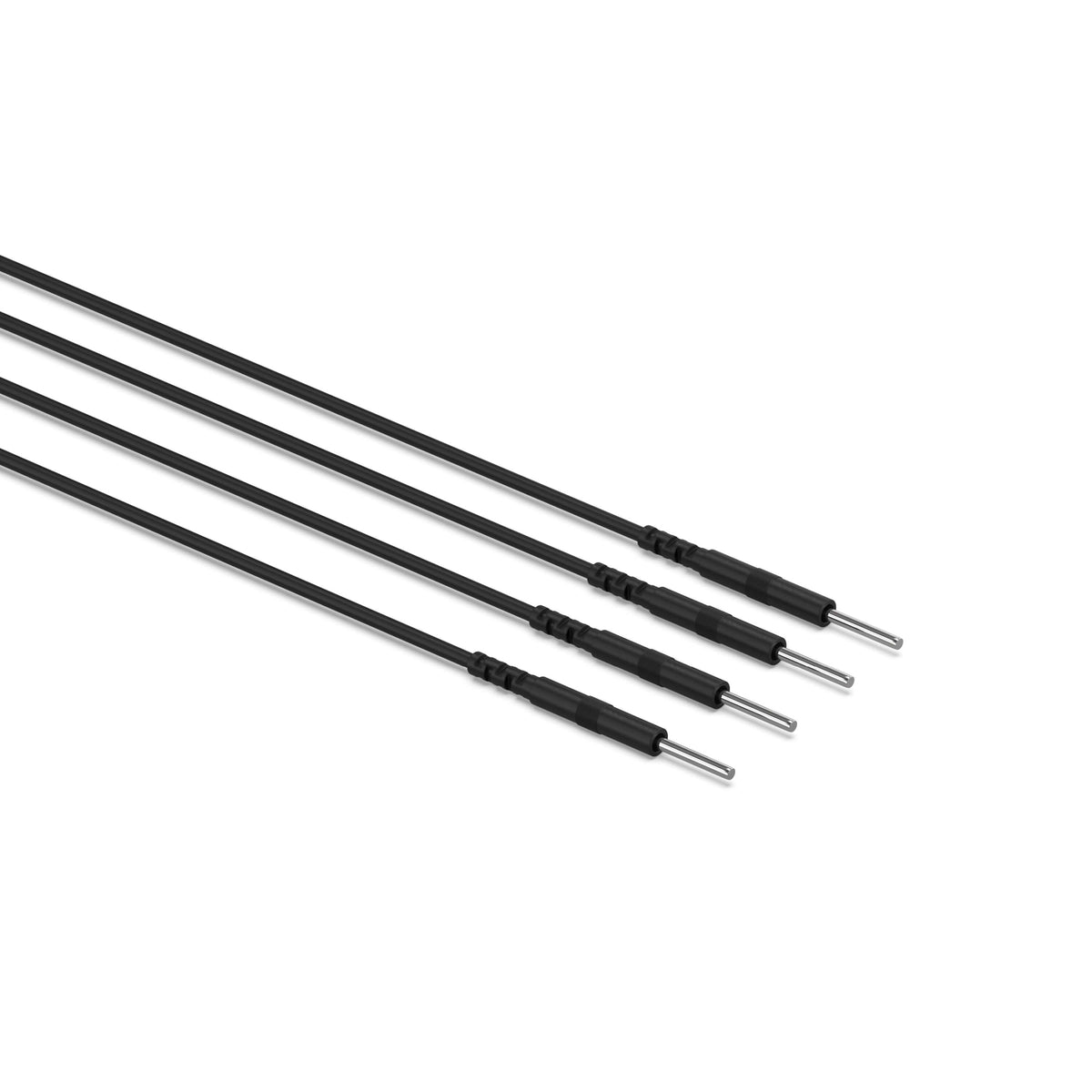
The KONGZEE 4-in-1 TENS and EMS unit includes separate TENS, EMS, Massage and DIY modes, independent A and B intensity controls, 40 intensity levels and reusable 2mm pin electrodes. These controls provide adjustment options; they do not diagnose back pain or make the unit suitable for every condition.
Frequently Asked Questions
Can I place a TENS pad directly on my spine?
Use healthy soft tissue around the painful lower-back region rather than the bony center of the spine. Follow the manual or a clinician-confirmed pattern.
Can I use TENS for a herniated disc?
TENS may temporarily change pain perception for some people, but it cannot reverse or repair a herniated disc. Symptoms that include weakness, spreading numbness or bladder or bowel changes need medical assessment.
Should my back muscles contract during TENS?
TENS generally produces tingling without a forceful contraction. Check that TENS mode is selected and reduce intensity if the muscles move strongly or the sensation is uncomfortable.
Can I sit or walk while using TENS?
Only if the device instructions allow it, the pads and leads remain secure and the activity creates no fall or entanglement risk. Never use TENS while driving or operating machinery.
Does TENS cure chronic lower-back pain?
No. TENS may provide temporary symptom relief, but it does not cure chronic back pain or correct its underlying cause. Long-term care often combines education, movement and other individualized measures.
Reviewed September 16, 2026. This article is educational and does not replace diagnosis, medical advice, rehabilitation or the instructions supplied with your device.






Leave a comment
All comments are moderated before being published.
This site is protected by hCaptcha and the hCaptcha Privacy Policy and Terms of Service apply.